 WhatsApp
How to plan your first LIVE content series
Give viewers a clear reason to join, then build an episode format you can prepare, present and improve consistently.

A live series starts with an idea you can return to from different angles. Knowing your subject is useful, but a live session needs further decisions: what should viewers take away, how will you open, and what happens when nobody asks a question? Answering these before you start gives each episode a workable direction.
For creators in Dubai and across the Middle East, the first step is an editorial plan that fits your language, audience and available time. Build a small pilot you can learn from before announcing an ambitious ongoing schedule.
1. Define the promise of the series
Complete this sentence: “In each episode, I help viewers…” Choose an outcome you can reasonably explore in one session. “Talking about design” leaves the subject open. “Organising a small home workspace using what you already own” suggests concrete examples and useful questions.
Name the intended viewer, too. A beginner needs different explanations from an experienced enthusiast. Choose a starting level and explain unfamiliar terms. You can broaden the series later; trying to serve every level immediately makes preparation harder.
Check that the idea can sustain several episodes
Draft a short set of possible titles under the same promise. If they all lead to the same answer, refine the angle. If every title requires an entirely different presenting style, find a clearer connection between them.
2. Keep the structure familiar while topics change
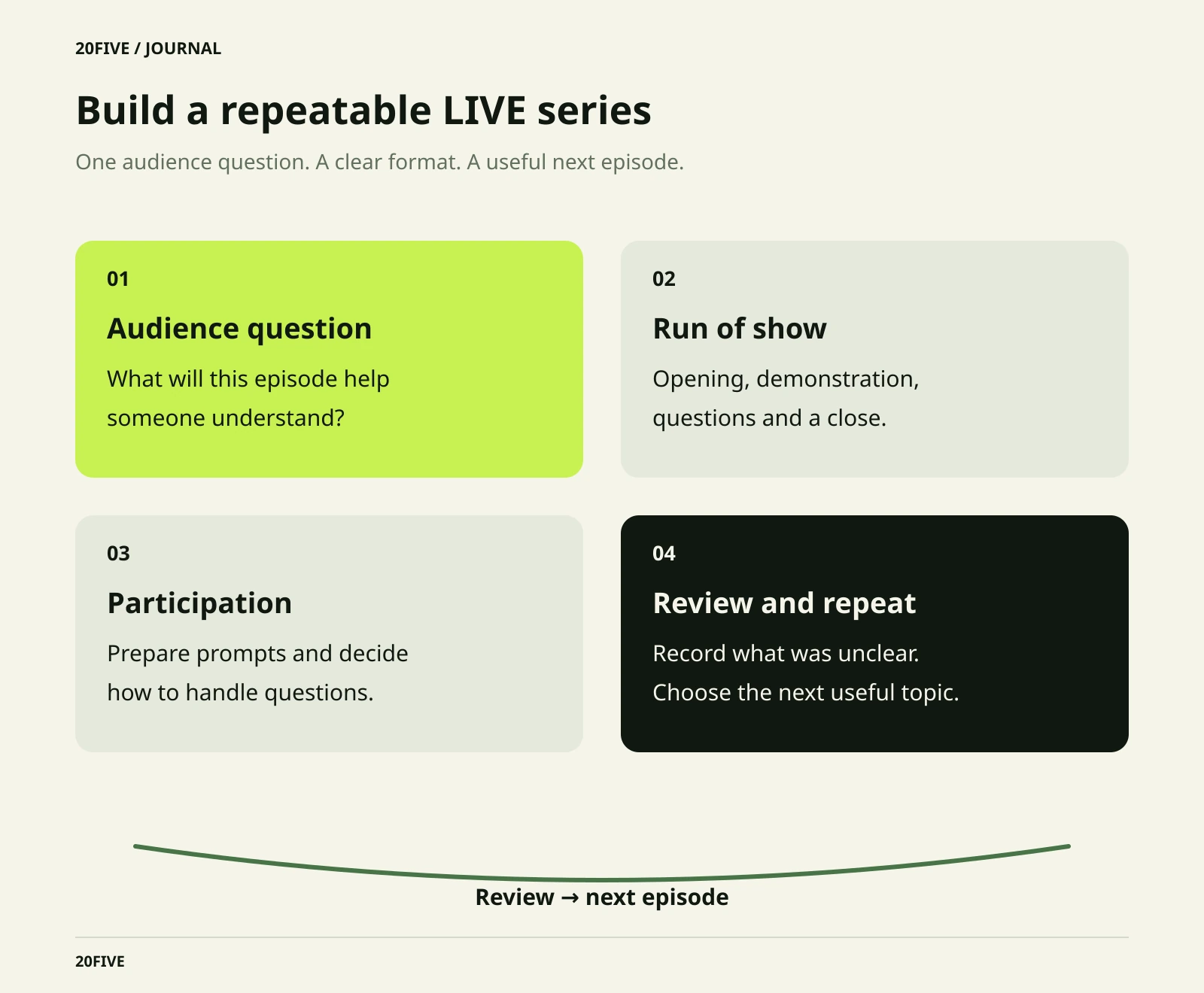
Use a simple sequence: introduce the question, work through an example, invite participation, then close with a takeaway. Give each section a purpose rather than scripting every sentence. This creates a route back when the conversation wanders.
For a hypothetical workspace series, one episode could identify sources of clutter, another could arrange everyday tools, and another could review the arrangement after use. The central promise stays consistent while the question changes. This is an illustrative editorial example, not a 20Five programme or case study.
Prepare a short context reset
Write a sentence you can naturally revisit: “Today we’re deciding what belongs on the desk and what can be stored elsewhere.” Use it at a transition instead of repeating the entire introduction. Someone joining later can then understand the current discussion.
3. Invite participation without depending on it
Prepare questions with a clear scope. “Which item do you search for every morning?” gives viewers a more specific starting point than “Any thoughts?” Connect the question to the example, then allow a pause before continuing.
Have your own example ready for each prompt. If the audience is quiet, continue through the planned material without pressuring people to respond. A late question can join the conversation at a suitable point; you do not need to interrupt every explanation immediately.
4. Make language and timing explicit
Choose your main presentation language and the dialect you use naturally. If you welcome questions in Arabic and English, decide how you will summarise each question and answer so the audience can follow. Repeated language changes without context can make an otherwise simple explanation harder to track.
When announcing a session across markets, include its date, time and time zone. Pick a schedule that leaves you room to prepare and review. Use early sessions to learn whether the timing is workable rather than assuming one universal best hour.
5. Prepare a running order and content boundaries
Keep a short reference sheet beside you: the main question, examples, transitions and closing point. Include a phrase for redirecting a long or unrelated question, such as “That deserves its own session; let’s finish this example first.”
Decide which personal details you will keep private and check what is visible behind you or on any screen you show. Prepare a fallback for a technical interruption. A short note of the last completed point can help you resume the explanation or revisit it at another time.
6. Review one practical improvement
After each session, record something that was clear, something that needed shortening and a question worth exploring. Separate observation from interpretation: “Nobody answered this prompt” describes what happened; “The audience dislikes the topic” needs more evidence.
Choose a specific change for the next episode, such as a shorter opening or an earlier demonstration. Keep the rest of the format stable enough to compare. If you review available performance data, record what each measure means and the period it covers. Avoid judging the whole series from a single session.
First-episode checklist
- Is the promise clear to someone discovering the series?
- Does each episode answer a distinct question?
- Are the opening, example, participation prompt and close prepared?
- Can you continue if nobody asks questions?
- Are language, date and time zone clear?
- Have you set privacy boundaries and an interruption plan?
- Do you know what you will review afterwards?
If you are exploring a TikTok Creator Network, bring this plan into a discussion about your goals and the support actually available. Start with the 20Five TikTok Creator Network page to prepare the questions you want answered before deciding.
Related reading
Take the next step
Explore the relevant 20Five pathway and discuss a clear scope before taking the next step.
More from the journal.

How to write a creator gifting brief before shipping the product
A product cannot explain the assignment on its own. Use this template to agree content, timing, publishing and rights before it ships.
Read the guide
How to keep self-filmed UGC clear and useful
Natural, clear content starts before recording. Use simple checks for sound, image and message accuracy before the final handover.
Read the guide
How to choose the right creator for your brand
Follower count cannot answer every question. Review audience relevance, presentation style and production fit before building your shortlist.
Read the guide